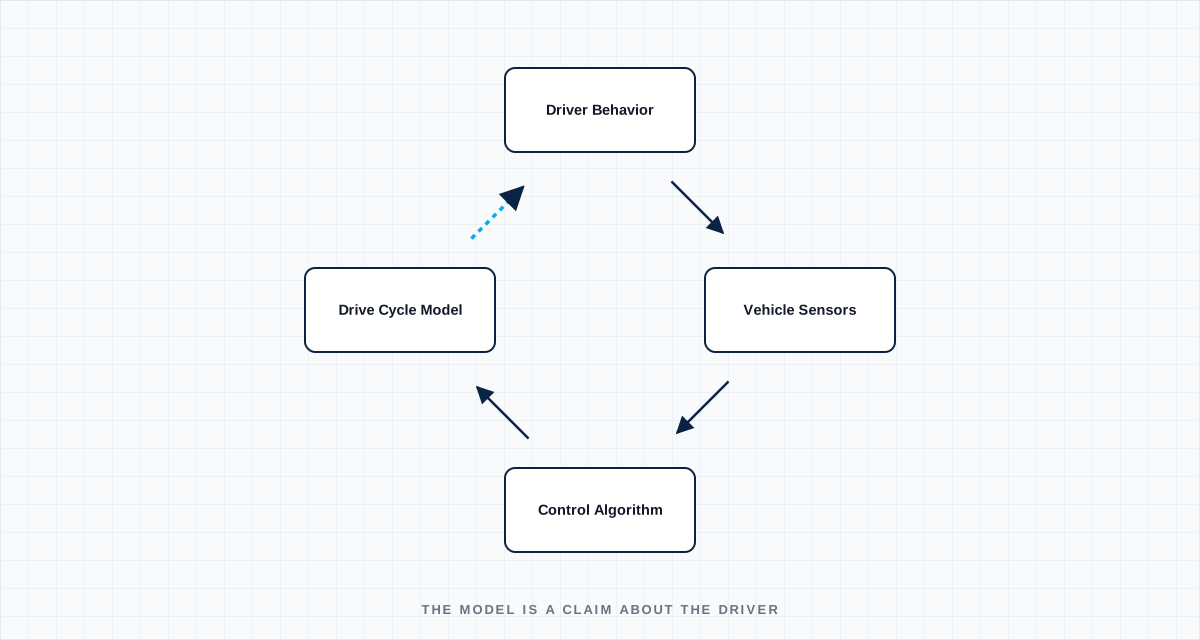
Every EV powertrain control strategy — thermal management, battery derating, torque delivery — is validated against a set of standardized or internally-defined drive cycles, which are, at their core, a mathematical model of how people drive. That model is necessary and useful, and it is also, unavoidably, a simplification. Real driver behavior diverges from standardized drive cycles in specific, well-documented, and knowable ways, and a control system validated only against the model — not against the range of real behavior the model was simplifying — is operating outside its actual validation envelope the moment a real driver's behavior diverges enough from the -human-factors.svg)
The gap between a drive cycle and a driver
Standardized drive cycles are built to be representative and repeatable, which means they smooth out exactly the kind of behavioral extremes that stress a system the hardest: repeated aggressive acceleration events in quick succession, sustained high-speed driving in hot ambient conditions, towing or heavy-load driving that changes thermal and electrical load profiles substantially from the passenger-vehicle assumptions baked into most standard cycles. None of these behaviors are rare edge cases in an absolute sense — they're common enough in the real customer population that a system validated only against smoothed, representative cycles will encounter them regularly in the field, just not during validation.
This matters specifically for thermal derating strategies: a control algorithm tuned to avoid unnecessary derating during "normal" driving, validated against a drive cycle that never sustains the specific combination of high ambient temperature and repeated hard acceleration a subset of real customers actually produce, can either derate too conservatively (a customer experience problem) or not conservatively enough (a hardware margin problem) for that specific behavioral segment — and the validation program, built around the representative cycle, may never surface which failure mode is actually occurring until field data accumulates.
Charging behavior as a specific case
Real-world charging behavior diverges from lab-characterized charging profiles in a specific, recurring way: customers frequently charge in short, partial sessions rather than the full-cycle charge events that battery and thermal validation typically characterizes most thoroughly, and they frequently charge again shortly after a trip, when the pack is already warm from driving rather than at the ambient-temperature starting condition most charging validation assumes as a baseline. This combination — partial-cycle charging, elevated starting temperature — is exactly the kind of realistic-but-non-standard condition that a charging control strategy validated primarily against clean, full-cycle, ambient-start conditions may not have been explicitly tuned for.
Treating behavior as a design input, not an assumption
The practical shift this requires is treating the range of real driver and charging behavior as an explicit design input, characterized from actual field telemetry where it's available, rather than treating a standardized drive cycle as a sufficient proxy for "how the system will actually be used." This doesn't mean discarding standardized cycles — they remain essential for consistent, comparable validation — it means supplementing them with validation scenarios built from the specific behavioral extremes real customer populations are known to produce, particularly around thermal loading sequences (drive-then-charge, repeated hard acceleration in hot ambient) that standardized cycles smooth away by design.
A control system is only as robust as the behavioral range it was actually tested against, and the honest version of that statement is uncomfortable: most control systems are tested against a model of the driver, not against drivers.
Define the boundary
Name the operating state, interfaces, tolerances and degraded conditions. A test without a boundary only proves the sample survived once.
Capture the right signal
Choose measurements fast and close enough to the mechanism to explain cause, sequence and margin—not just the final alarm.
Set a decision rule
Agree before the test what passes, what triggers redesign and what uncertainty requires another experiment.
Turn the lesson into a validation plan.
Bring us the requirement, failure signature or architecture boundary. We will help frame the evidence needed to make the next decision.