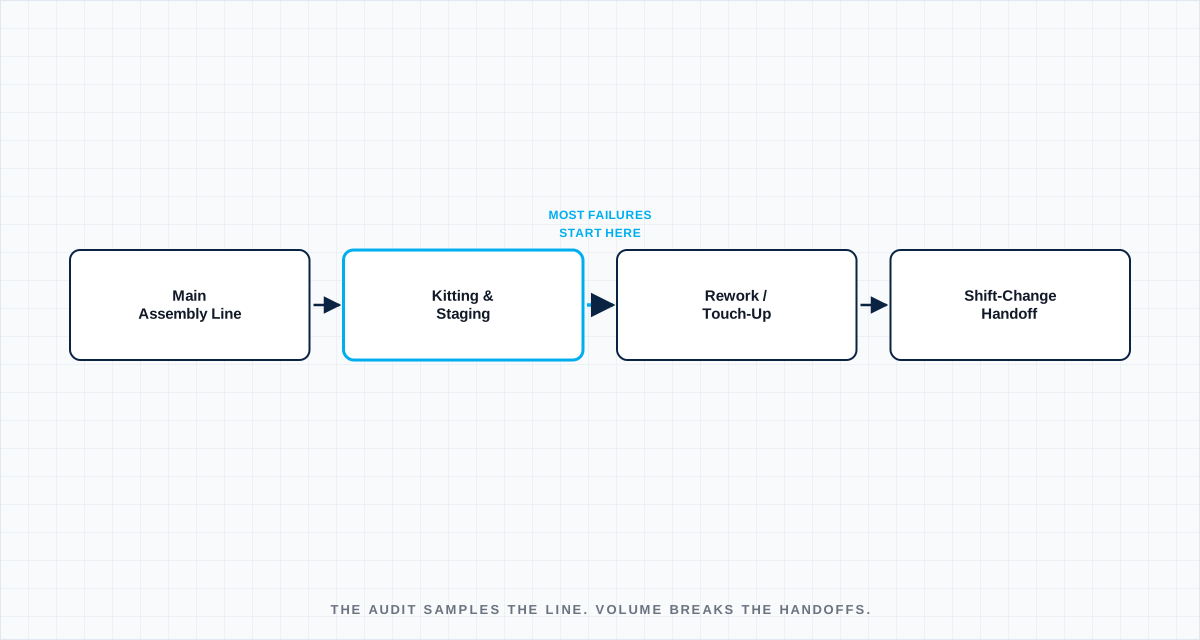
An ESD-safe production process can pass its qualification audit — grounded workstations, wrist straps in place, ESD flooring measured within spec — and still let latent device damage through to the field, because the audit checks the process as designed, on a quiet day, with a handful of workstations under direct observation. The failure mode that actually matters is different: it's what happens at the specific handoff points a process audit rarely captures, once a line is running at full volume, full staffing, and normal productioon-volume.svg)
Latent damage doesn't fail at incoming inspection
The reason ESD control gets under-invested in relative to its actual risk is that ESD damage is frequently latent, not catastrophic — a component with partial junction damage from an uncontrolled discharge event will often still pass functional test at incoming inspection and initial board test, and then fail in the field months later under thermal or electrical stress the compromised junction can no longer tolerate. This creates a feedback loop problem: the production line that caused the damage gets no signal that it did, because the failure shows up downstream, disconnected in time and in ownership from the process that created it.
Where the process actually degrades at volume
Every ESD-safe process has procedural handoff points that work correctly when validated in isolation and degrade specifically under production volume pressure: component staging and kitting done by a different team than the one that assembles, with different training and different incentive to move quickly; rework and touch-up stations that see components outside their original ESD-safe packaging for longer than the main line does; and shift-change handoffs where grounding continuity checks are the first thing skipped when the line is behind schedule. None of these show up in a qualification audit that samples the main assembly line under normal conditions, because the failure isn't in the main line's designed process — it's in the adjacent handling steps the audit doesn't typically sample with the same rigor.
What actually catches this before it becomes a field return
The check that catches this isn't a more thorough version of the same audit — it's shifting the audit's attention to the specific handoff points identified above, under real shift-change and rework conditions rather than a controlled walkthrough, combined with tracking field-return failure signatures against which line and which shift produced the affected units. A production process that's ESD-safe on paper and unmonitored at its actual weak points is functionally indistinguishable from one that isn't ESD-safe at all, until the field-return data eventually makes the difference visible — expensively, and much later than a targeted process audit would have.
Define the boundary
Name the operating state, interfaces, tolerances and degraded conditions. A test without a boundary only proves the sample survived once.
Capture the right signal
Choose measurements fast and close enough to the mechanism to explain cause, sequence and margin—not just the final alarm.
Set a decision rule
Agree before the test what passes, what triggers redesign and what uncertainty requires another experiment.
Turn the lesson into a validation plan.
Bring us the requirement, failure signature or architecture boundary. We will help frame the evidence needed to make the next decision.