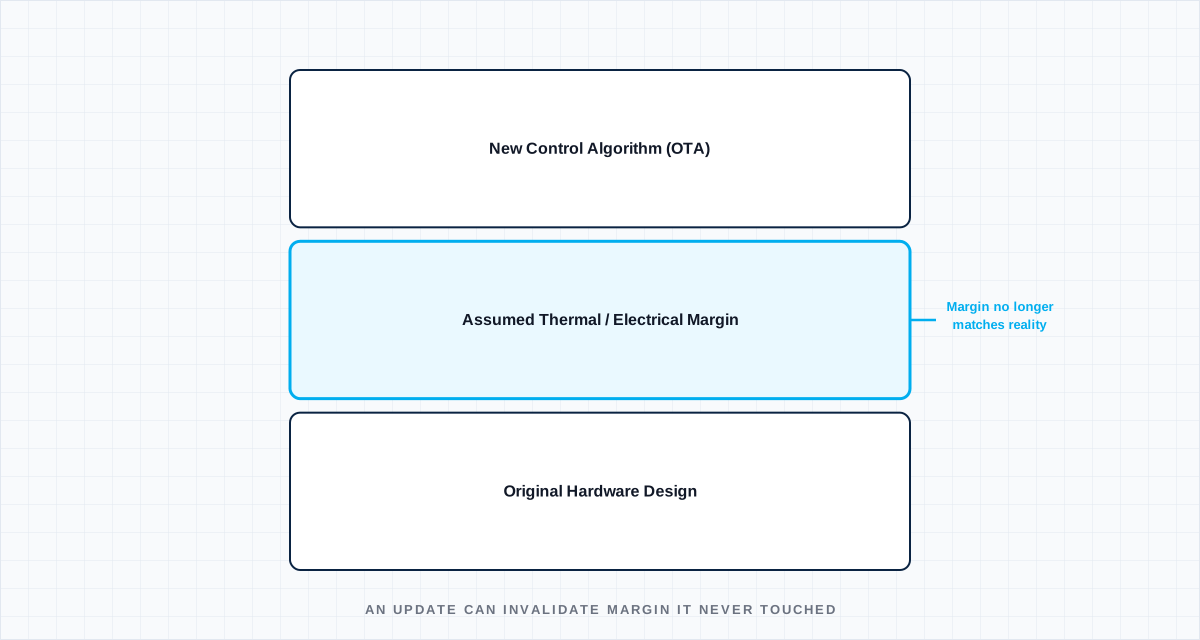
Hardware design margin is almost always calculated against an assumed control behavior — a specific switching frequency, a specific current ripple profile, a specific duty cycle pattern under specific operating conditions. That assumed behavior lives in the control firmware, and the moment firmware becomes field-updatable, the hardware's design margin is no longer protected by anything except the discipline of the team writing future firmware updates to stay inside constraints they may never have re-assumptions.svg)
The margin was calculated against a control strategy, not a component rating
A power module's thermal design typically has margin against a specific worst-case duty cycle derived from the intended control algorithm's behavior — not against the component's absolute maximum rating, which would be far more conservative and far more expensive to design for. If a later firmware update changes the control strategy — a more aggressive torque response curve, a modified charging profile intended to reduce charge time, an updated thermal derating curve tuned from field data — that change can push the power stage into a duty cycle the original hardware thermal design never accounted for, even though every individual switching event still respects the component's absolute maximum ratings on a datasheet.
This is a genuinely dangerous gap because it's invisible from the software side. The firmware update passes every functional test, respects every documented electrical limit, and improves the metric it was designed to improve. The hardware margin it silently consumes was never expressed as a constraint the firmware team could check against, because it was implicit in the original control algorithm rather than written down as an explicit limit.
Where this shows up
Battery charging profile updates are a recurring example: a firmware change intended to reduce charge time by increasing charge current under certain conditions can shift thermal load on the charging power path in ways the original hardware thermal design, sized against the original charge profile, didn't anticipate — particularly in edge cases like elevated ambient temperature combined with an already-warm pack from recent driving, a combination the original validation matrix may not have specifically tested if the original charge profile made that combination thermally benign.
What actually prevents this
The fix isn't restricting what firmware updates are allowed to do — it's making the hardware's actual design margin an explicit, documented constraint that any future control strategy change gets validated against, not an implicit property of the original control algorithm that nobody wrote down as a limit. Concretely: hardware design reviews should produce an explicit statement of the operating envelope (duty cycle range, thermal load profile, transient current limits) the thermal and electrical margin was calculated against — not just a statement of the component's absolute ratings — and that envelope needs to be a required check for any firmware change that affects switching behavior, charging behavior, or thermal management strategy, for the life of the platform, not just at initial release.
Without that explicit envelope on record, every future firmware team is operating on inherited assumptions they can't verify, updating a system whose real margin was never actually theirs to see.
Define the boundary
Name the operating state, interfaces, tolerances and degraded conditions. A test without a boundary only proves the sample survived once.
Capture the right signal
Choose measurements fast and close enough to the mechanism to explain cause, sequence and margin—not just the final alarm.
Set a decision rule
Agree before the test what passes, what triggers redesign and what uncertainty requires another experiment.
Turn the lesson into a validation plan.
Bring us the requirement, failure signature or architecture boundary. We will help frame the evidence needed to make the next decision.