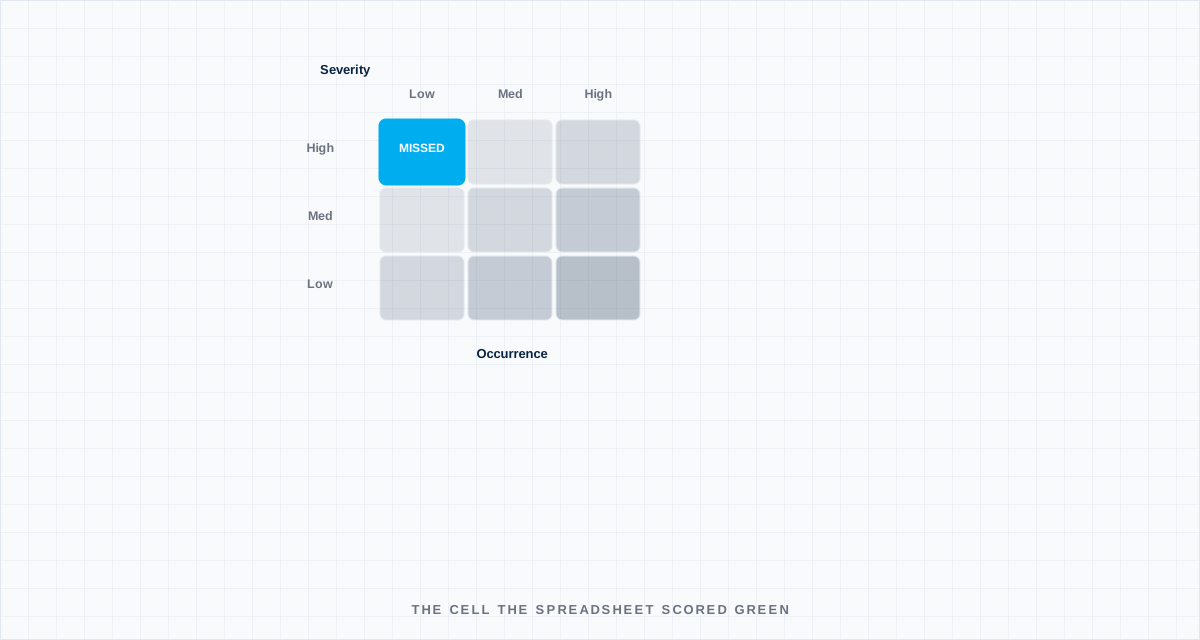
Every serious power electronics or energy storage program produces an FMEA — a systematic walk through failure modes, their effects, their severity, occurrence, and detection ratings, and the resulting risk priority number. It's a genuinely good tool, developed for good reasons, and it's also one of the most consistently hollowed-out documents on a program, because the incentive structure around it rewards completing the spreadsheet, not interrmpliance-exercise.svg)
How an FMEA becomes theater without anyone deciding it should
The drift is gradual and rarely deliberate. A program under schedule pressure needs the FMEA "done" by a milestone gate. The team populating it is often not the same team that made the original design decisions, working from block diagrams rather than from direct knowledge of where the design's actual weak points are. Severity and occurrence ratings get assigned based on generic categories rather than component-specific data, because gathering component-specific failure rate data for every line item is slow. Detection ratings assume test coverage that may not actually exist yet in the validation plan. None of this is dishonest — every step is a locally reasonable response to time pressure — and the cumulative effect is a document that looks rigorous, passes a gate review, and doesn't actually reflect where the design is fragile.
The tell: an FMEA that never gets updated after it's approved
The clearest sign of an FMEA that's become a compliance artifact rather than a living risk tool is that it stops changing after initial approval — even as the design changes, even as test results come in that should update occurrence or detection ratings, even after a failure occurs during validation that clearly maps to a row in the document. A genuinely useful FMEA is revised continuously as real evidence arrives. One that was built once for a gate review and then archived was never really doing its job past that gate.
Where this actually bites
The failure that eventually happens is very often traceable, after the fact, to a row that existed in the FMEA with a risk priority number low enough not to trigger action — not because the failure mode was truly low-risk, but because the occurrence or detection rating was optimistic, assigned under the same time pressure that produced the rest of the document. Post-incident reviews finding "it was in the FMEA" are common, and they're a specific kind of uncomfortable, because they mean the tool that was supposed to catch the problem did technically capture it, just with a rating that didn't reflect reality.
What makes an FMEA actually useful
Risk ratings need to be argued, not just assigned — every occurrence and detection rating should be traceable to actual data (field history, test results, physics-based analysis) or explicitly flagged as an engineering estimate pending data, not presented with the same confidence either way. Cross-functional review matters more than document completeness: an FMEA reviewed only by the team that wrote it tends to validate that team's existing mental model of the design's risks, and misses the failure modes an outside perspective — a different subsystem team, a manufacturing engineer, a field service perspective — would catch immediately. And the document needs an explicit owner responsible for updating it as real evidence arrives, not a one-time deliverable that satisfied a gate and was never touched again.
Define the boundary
Name the operating state, interfaces, tolerances and degraded conditions. A test without a boundary only proves the sample survived once.
Capture the right signal
Choose measurements fast and close enough to the mechanism to explain cause, sequence and margin—not just the final alarm.
Set a decision rule
Agree before the test what passes, what triggers redesign and what uncertainty requires another experiment.
Turn the lesson into a validation plan.
Bring us the requirement, failure signature or architecture boundary. We will help frame the evidence needed to make the next decision.