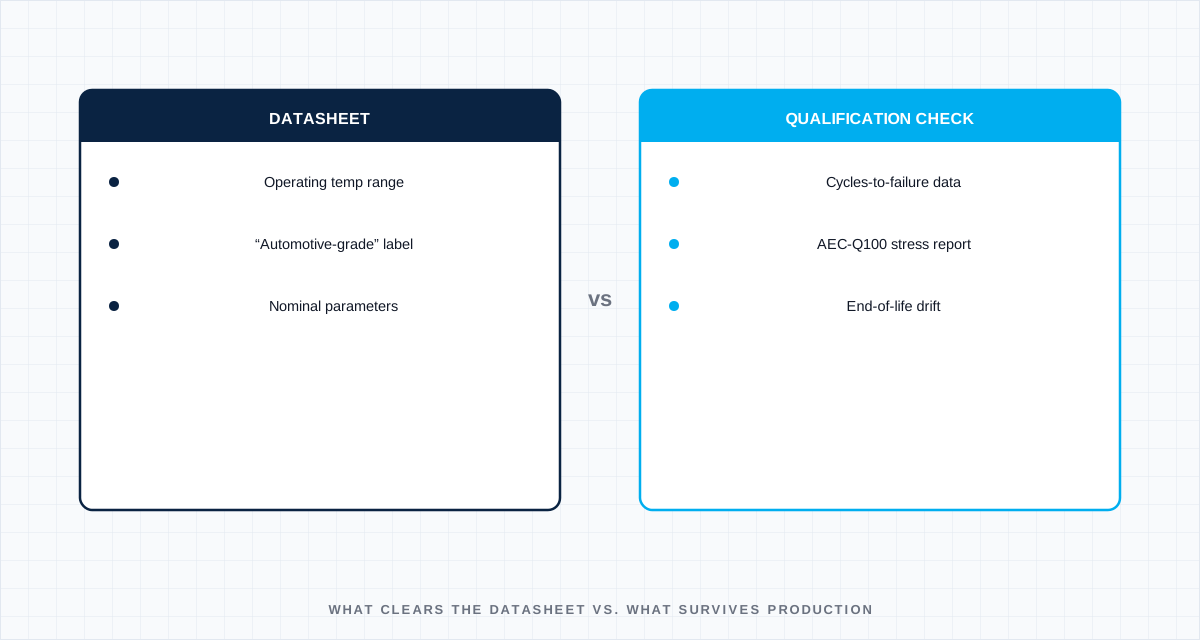
A microcontroller that clears every line item on the datasheet — right core, right peripherals, right price — can still be the wrong part for production. The failure modes that actually show up later almost never come from a spec the datasheet got wrong. They come from questions the datasheet was never going to answer in the first place: what happens after ten thousand thermal cycles, what happens when the fab allocates your die revision to a bigger customer, and what "automotive-grade" is actually certifying versus what a buyer assumes it's certifying.
![What clears re cycling and long-term reliability, not just the spec sheet
An MCU's operating temperature range on the datasheet describes where it functions, not where it survives for the life of the product. Solder joint fatigue, wire-bond degradation and package-level stress accumulate with every thermal cycle, and the cycle count that matters is the one the end application actually sees — a chassis-mounted controller near a power stage sees a very different thermal history than a bench sample sees in a lab running a handful of functional tests. Two MCUs with identical operating-range numbers can have meaningfully different cycles-to-failure distributions once you look at the underlying package qualification data (AEC-Q100 grade and the specific stress test results behind it), and that data is rarely in the top-line datasheet — it's in the qualification report, and it's worth asking for before committing a design to a part.
The other reliability question that doesn't show up in a parametric search is long-term parameter drift: clock accuracy, ADC reference stability and I/O drive strength at end-of-life versus day one. For a part that's supposed to be in the field for ten-plus years, day-one characterization tells you almost nothing about year eight.
Second-sourcing strategy before you need it, not after an allocation crisis
Every allocation shortage looks obvious in hindsight and invisible in advance, which is exactly why second-source planning has to happen at the design-in stage, not after a lead time quote comes back at fifty-two weeks. The real second-sourcing question isn't "is there a pin-compatible part from another vendor" — it's whether the toolchain, the peripheral register map, and the firmware's low-level assumptions can actually move to that alternate part without a re-validation cycle that takes longer than the shortage does. A second source that requires rewriting the HAL layer under schedule pressure is a second source in name only.
This is where treating MCU selection as a single-part decision instead of a platform decision costs programs the most. Committing early to a part family with a genuine multi-vendor footprint — where the register-level differences between vendors are known and bounded in advance — turns a future allocation crisis into a firmware config change instead of a redesign.
What "automotive-grade" actually guarantees, and what it doesn't
"Automotive-grade" is a real qualification standard (AEC-Q100), not a marketing label, but it certifies a specific, bounded set of stress conditions — it doesn't certify that the part is correctly derated for your specific thermal, EMI or functional-safety context. A Grade 1 automotive MCU dropped into a design without checking the application's actual ambient temperature profile, the board-level EMI environment, or whether the part's built-in safety mechanisms actually satisfy the ASIL level the system needs is still a design risk, just one wearing a qualification badge that makes it look resolved.
The check we actually run before recommending an MCU for production isn't "does it say automotive-grade" — it's cross-referencing the qualification report against the application's real operating envelope, confirming second-source viability at the platform level, and pricing in the requalification cost of every alternate part before the allocation crisis makes that decision for us.
Define the boundary
Name the operating state, interfaces, tolerances and degraded conditions. A test without a boundary only proves the sample survived once.
Capture the right signal
Choose measurements fast and close enough to the mechanism to explain cause, sequence and margin—not just the final alarm.
Set a decision rule
Agree before the test what passes, what triggers redesign and what uncertainty requires another experiment.
Turn the lesson into a validation plan.
Bring us the requirement, failure signature or architecture boundary. We will help frame the evidence needed to make the next decision.