"Deterministic" is one of the most frequently claimed and least frequently specified properties in industrial networking equipment. It gets used as a general assurance — this network is reliable, this switch is industrial-grade — far more often than it gets used as an engineering requirement with an actual bound: a maximum latency, a maximum jitter, under a specific, stated traffic load. Without that bound, "deterministic" is a marketing adjective, not an engineering property, and a network architecture built on the marketing version of the word will pass commissioning and still misbehave once reaterministic-factory-networks.svg)
Not all industrial traffic has the same tolerance
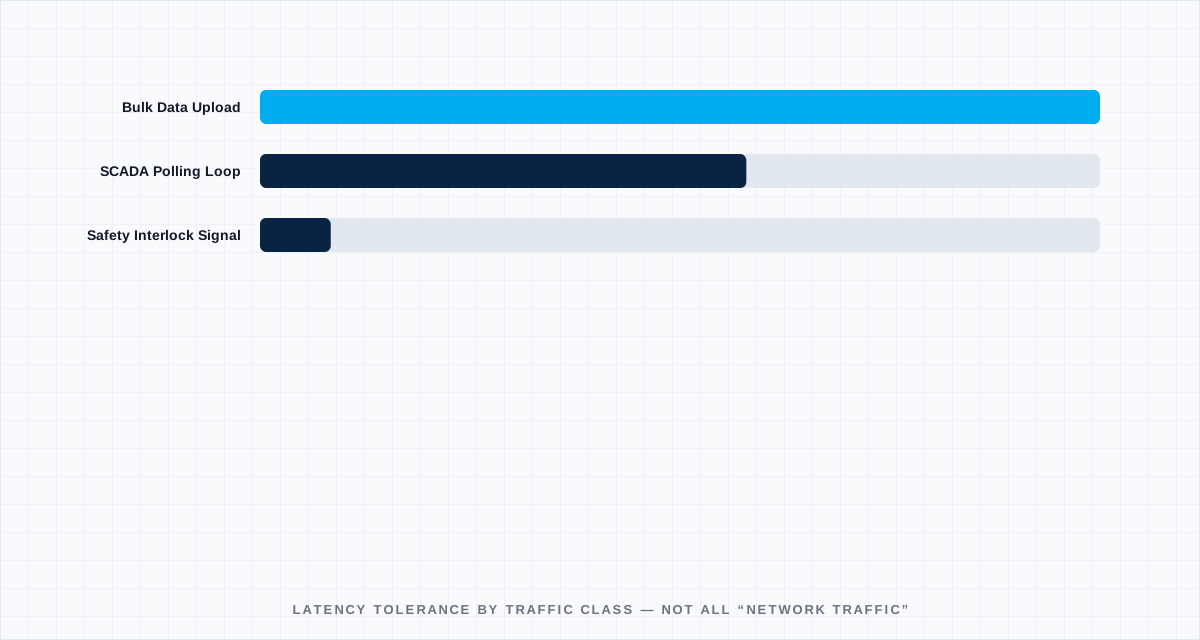
A safety interlock signal, a SCADA polling loop, and a bulk IIoT data upload are frequently carried on the same physical network, and they have wildly different tolerance for the same failure modes. A safety interlock signal that arrives 50 milliseconds late isn't degraded — it's a safety failure, because the control system's timing assumptions were built around a specific worst-case latency bound. A SCADA polling loop that's occasionally late produces a stale data point that's usually tolerable. A bulk data upload that's delayed produces no operational consequence at all. Architecting a network as if all three have equivalent requirements — "it's all just network traffic" — means either over-engineering the whole network to the safety-signal standard, which is expensive, or under-engineering it to the bulk-data standard, which eventually produces a safety-relevant timing failure.
Where the determinism claim actually gets tested
A switch or protocol's deterministic behavior is validated by its vendor under a specific, usually best-case, traffic load — and the claim frequently doesn't specify what happens as multiple traffic classes contend for the same physical link under real production conditions, with every automation cell's normal traffic present simultaneously, not one cell's traffic tested in isolation. Traffic prioritization (time-sensitive networking, QoS tagging, or hard segmentation onto separate physical or logical paths) has to be engineered and tested under that combined load, because the deterministic behavior a component exhibits alone frequently degrades in ways that only appear once it's carrying the actual mix of traffic classes a live line produces.
Building to a stated bound instead of a claimed property
The fix is treating "deterministic" as a value to specify and test, not a property to assume: define the actual maximum acceptable latency and jitter for each traffic class on the network — safety signals, control loops, bulk data — architect the physical and logical segmentation to guarantee those bounds under full combined load, and validate under that full load before commissioning, not after. A network that's deterministic for one cell's traffic, tested alone, and unverified once every other cell's traffic joins it isn't actually deterministic — it's untested, wearing a word that sounds like it isn't.
Define the boundary
Name the operating state, interfaces, tolerances and degraded conditions. A test without a boundary only proves the sample survived once.
Capture the right signal
Choose measurements fast and close enough to the mechanism to explain cause, sequence and margin—not just the final alarm.
Set a decision rule
Agree before the test what passes, what triggers redesign and what uncertainty requires another experiment.
Turn the lesson into a validation plan.
Bring us the requirement, failure signature or architecture boundary. We will help frame the evidence needed to make the next decision.