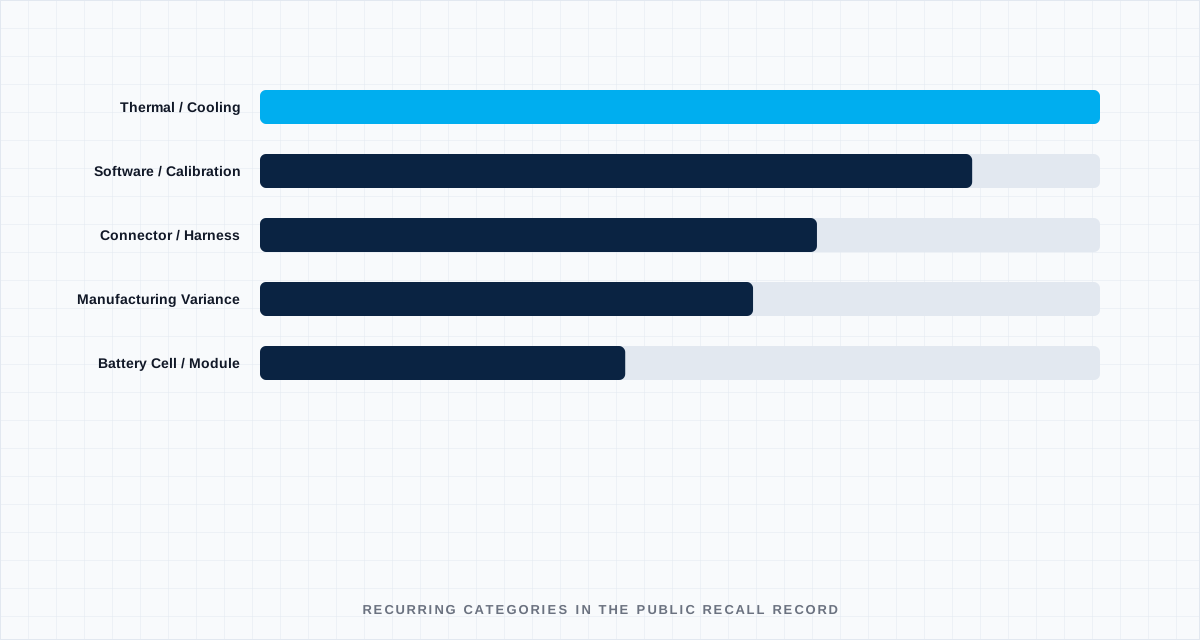
Public recall filings and technical service bulletins across the EV industry, viewed in aggregate rather than incident by incident, cluster around a fairly small number of recurring root-cause categories. This isn't a criticism of any specific manufacturer — every company building high-voltage power electronics at automotive volume is exposed to the same categories of risk, because the categories come from the underlying physics and manufacturing realities of the technology, not from any one company's specific process. What's useful about looking at the pattern in aggregate is that it shows which categories of problem are common enough to plan for explicitly, rather than treating each one as a surprising, one-off event when it eventually shows up on acs-public-record.svg)
The categories that recur
Battery thermal events, almost always traced back to a specific cell or module-level defect (a manufacturing contamination, an internal short from a mechanical defect) rather than a fundamental chemistry problem — which is exactly why cell-level manufacturing quality and statistical sampling in acceptance testing matters as much as, or more than, the chemistry selection itself.
Charging system faults, frequently connector or contactor-related — welding, arcing, or connection degradation under repeated high-current cycling — rather than power electronics design errors in the strict sense. These tend to be mechanical and materials problems wearing an electrical symptom, discovered through cycles-to-failure that bench validation, run for a limited number of cycles under schedule pressure, didn't extend far enough to catch.
Software-related powertrain behavior, where a control software update — sometimes intended to fix an unrelated issue — produces unintended interaction with power electronics behavior under a specific, often rare, combination of conditions the update's own validation matrix didn't specifically cover. This is the software equivalent of the tolerance stack-up problem: individually correct changes, tested individually, that interact in combinations nobody explicitly checked.
Wiring harness issues — chafing, connector fretting, and, in real-world field conditions, rodent damage — that are unglamorous compared to power electronics failure modes but show up repeatedly in service data because a wiring harness is exposed to years of vibration, thermal cycling, and environmental conditions that are difficult to fully replicate in a validation lab within a normal program timeline.
Why "exotic" failures are rarer than expected
What's notable across the public record, in aggregate, is how rarely the root cause is a genuinely novel failure mode nobody could have anticipated. Almost every category above maps to a well-understood risk category — manufacturing variance, connector cycle life, software interaction effects, environmental durability — that a sufficiently rigorous test and validation program would have been structured to catch. The pattern isn't "the industry keeps discovering new physics." It's "the same known risk categories keep getting under-tested relative to their actual field exposure," usually because full validation against real-world duration, cycling, and environmental extremes is expensive and time-consuming relative to a program schedule.
What this means for a new program
The practical value of this pattern isn't predicting exactly what will fail — it's knowing which categories deserve validation depth disproportionate to how "solved" they might feel: connector and contactor cycle life testing extended well past the number of cycles a normal validation schedule budgets for, software update validation that explicitly tests interaction effects with existing control logic rather than only the new functionality in isolation, and environmental durability testing on wiring and connectors run long enough to surface the kind of gradual degradation that a short validation window will not reveal. None of this is exotic engineering. It's disciplined coverage of categories the industry's own public record already says matter.
Define the boundary
Name the operating state, interfaces, tolerances and degraded conditions. A test without a boundary only proves the sample survived once.
Capture the right signal
Choose measurements fast and close enough to the mechanism to explain cause, sequence and margin—not just the final alarm.
Set a decision rule
Agree before the test what passes, what triggers redesign and what uncertainty requires another experiment.
Turn the lesson into a validation plan.
Bring us the requirement, failure signature or architecture boundary. We will help frame the evidence needed to make the next decision.