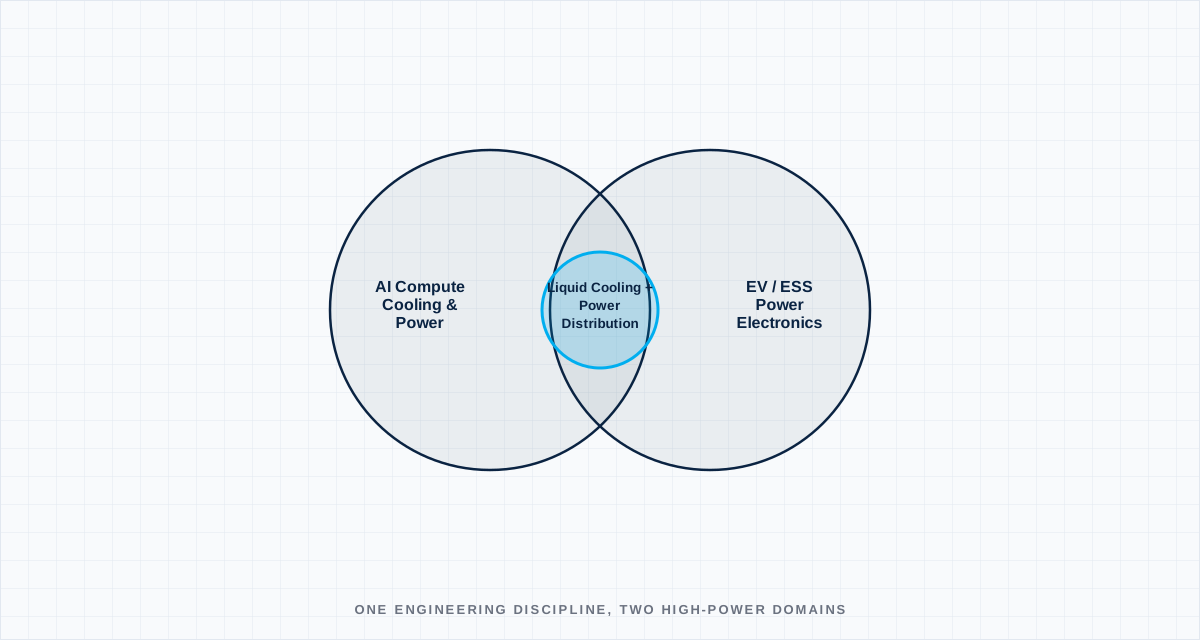
GPU rack density has pushed AI infrastructure into power distribution and cooling problems that industrial power electronics engineers have been solving for years in other domains — high-current power delivery to a dense, heat-concentrated load, and liquid cooling designed against a real thermal budget instead of a nominal one. It's the same underlying discipline applied to a newer application.
Power distribution at GPU-rack density
Rack-level power distribution for high-density GPU compute has to be engineered against real transient load behavior — GPU workloads draw power in sharp, correlated bursts across a rack, not the smooth, averaged load a nameplate power rating implies — the same transient-load discipline that traction inverter and BESS power conversion design already accounts for.
Liquid cooling beyond the data center
Liquid cooling loops for GPU racks share the same core engineering problem as cold-plate design for EV power modules and containerized battery storage: sizing the loop against the load's actual thermal profile and the facility's real ambient and maintenance constraints, not a vendor reference design assumed to transfer unchanged.
Where AI infrastructure engineering meets power electronics
The overlap between AI compute infrastructure and industrial power electronics isn't superficial — it's the same power distribution and liquid-cooling engineering discipline, applied to whichever high-power, heat-dense system needs it. Programs that treat AI infrastructure and industrial power electronics as unrelated disciplines often end up solving the same thermal and power-delivery problem twice, independently, with two different teams learning the same lessons on two different schedules.