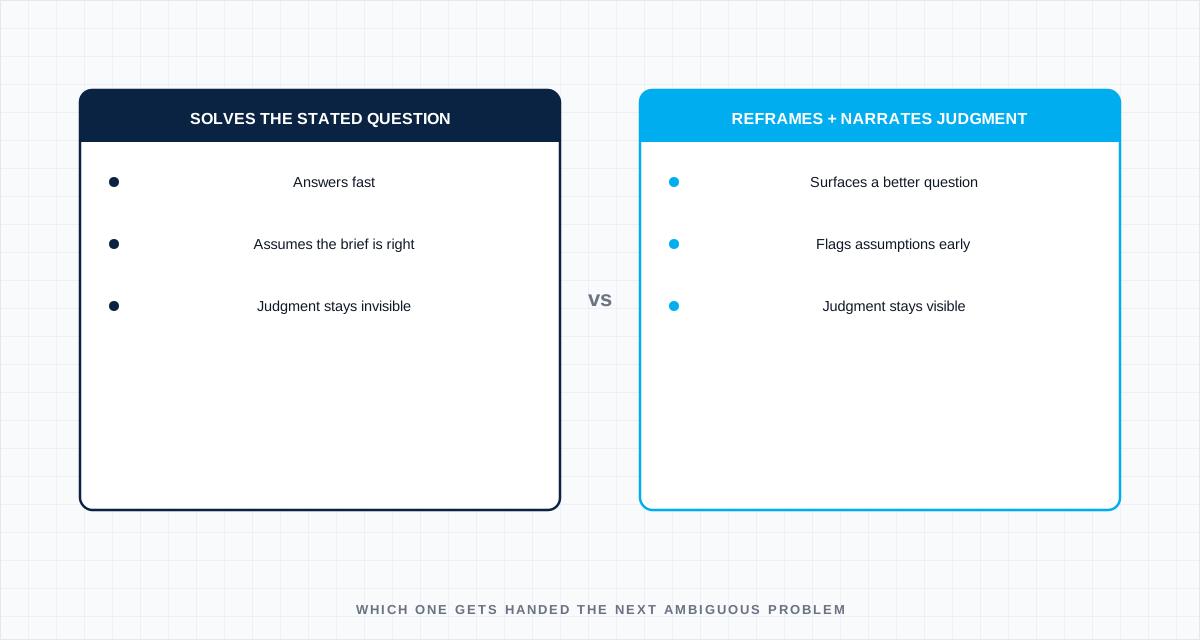
Every engineering organization says it wants people who can "own ambiguous problems" — the ones without a clear spec, a known owner, or an obvious first step. Very few can describe what actually earns an engineer that trust, and the default explanation — tenure, seniority, a track record of shipped work — doesn't hold up well against direct observation. Plenty of senior, technically excellent engineers never get handed the genuinely undefined problems; plenty of relatively junior engineers do. The difference tends to come down to a specific, learnable pattern, and it has surprisingly little to do with raw tecus-problems.svg)
The pattern isn't "has the most answers"
The instinct is to assume ambiguous problems get handed to whoever has the deepest technical knowledge, but in practice they get handed to whoever has demonstrated they'll come back with a clearer version of the problem, not just an answer to the version they were originally given. An ambiguous problem statement is usually wrong or incomplete in some way nobody has noticed yet, and the engineer who gets trusted with the next one isn't the one who answered the stated question fastest — it's the one who, in answering it, surfaced that the question itself needed revising, and said so clearly instead of quietly solving the wrong problem well.
Visible judgment under incomplete information
The second part of the pattern is narrower than "good communication" — it's specifically making a judgment call visible while it's still reversible, instead of either asking for permission on every small decision (which signals the person can't be trusted with ambiguity at all) or silently making significant judgment calls and only surfacing them once they're baked into a finished deliverable (which signals the opposite problem — the person can't be trusted to loop anyone in). The engineers who get repeatedly handed harder, less-defined problems tend to narrate their judgment calls as they make them: here's the ambiguity, here's the assumption I'm making to move forward, here's where I'd want a second opinion before this gets expensive to unwind. That narration is what lets someone else extend trust incrementally, on a track record of visible reasoning, rather than being asked to extend it all at once on faith.
Why this compounds and tenure alone doesn't
Tenure earns exposure to more ambiguous problems over time by default, which is why it correlates with the trust — but exposure isn't the same as the pattern that actually earns the trust faster than tenure alone would. An engineer who consistently reframes the real problem and narrates judgment calls visibly gets handed harder ambiguity earlier, because the cost of extending that trust is lower — the failure mode of "solved the wrong problem confidently" and "made an expensive call nobody else knew about" both become much less likely, and those are the two failure modes that make handing someone an ambiguous problem actually risky in the first place.
Define the boundary
Name the operating state, interfaces, tolerances and degraded conditions. A test without a boundary only proves the sample survived once.
Capture the right signal
Choose measurements fast and close enough to the mechanism to explain cause, sequence and margin—not just the final alarm.
Set a decision rule
Agree before the test what passes, what triggers redesign and what uncertainty requires another experiment.
Turn the lesson into a validation plan.
Bring us the requirement, failure signature or architecture boundary. We will help frame the evidence needed to make the next decision.