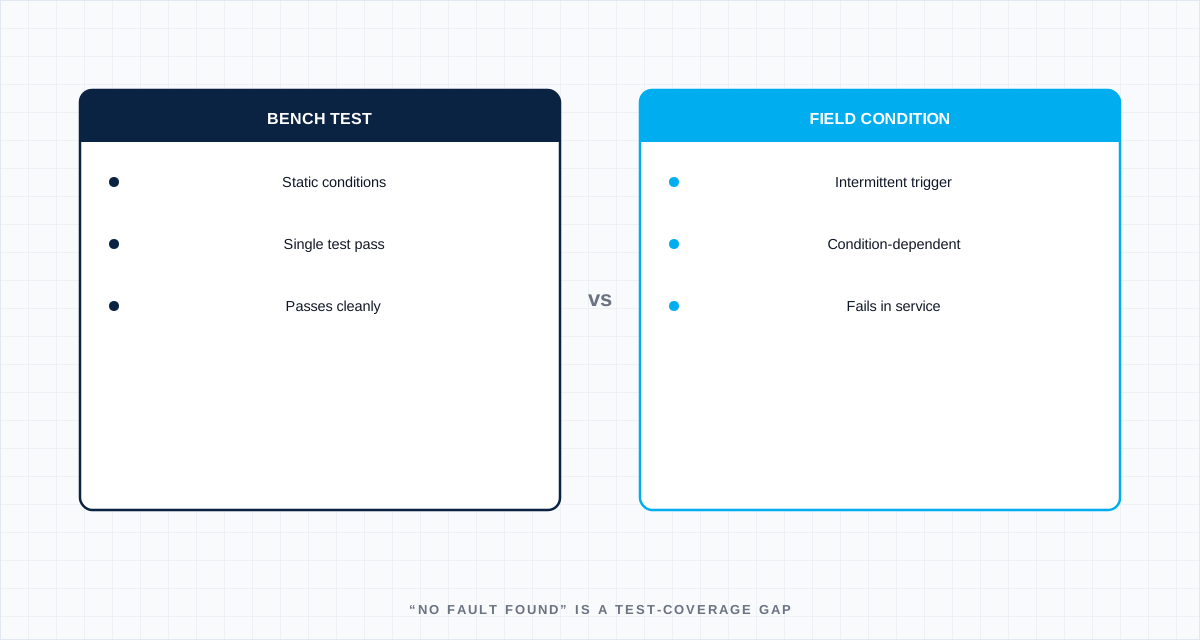
A component or module returns from the field flagged for a specific symptom, gets tested against standard bench acceptance criteria, passes every test, and gets classified No Fault Found (NFF) — closed out, often with an implicit or explicit attribution to user error, installation issue, or an unreproducible anomaly. NFF is a real and legitimate classification for some fraction of returns. It's also, across the electronics industry broadly, a classification that swallows a meaningful share of genuine intermittent design or manufacturing issues, simply because the standard bench test isn't structured to reproduce the specific condition that triggered the field symptom in the firt-found.svg)
Why "passes the bench test" doesn't mean "no fault"
A bench acceptance test validates a unit against a defined, standardized set of conditions — typically room temperature, nominal voltage, a specific functional test sequence. A field failure that's actually caused by a marginal timing issue that only manifests at elevated temperature, a connector that has good continuity at rest but intermittent contact under vibration, or a software state that only occurs after a specific, unusual sequence of operating conditions will pass a room-temperature, static bench test every time — not because the unit has no fault, but because the bench test doesn't recreate the condition under which the fault occurs.
This is precisely why NFF rates deserve scrutiny rather than acceptance at face value: a consistently high NFF rate for a specific symptom category, across enough units, is itself a signal — not that customers are consistently misreporting a working product, but that the standard test protocol has a blind spot relative to whatever field condition is actually triggering the reported symptom.
Where this specifically shows up in power electronics
Thermal-dependent intermittent faults. A marginal solder joint, a component operating near a threshold that shifts with temperature, or a timing margin that closes under thermal expansion will frequently test fine at bench ambient temperature and fail, or nearly fail, at a field-relevant temperature the standard test never applies.
Vibration and mechanical-stress-dependent connectivity issues. A connector or solder joint with marginal mechanical integrity can maintain electrical continuity indefinitely under static bench conditions and fail intermittently under the vibration profile of actual vehicle or field operation — a difference invisible to any test that doesn't include a representative vibration or mechanical stress element.
State-dependent software or firmware faults. A fault that only occurs after a specific sequence of operating states — a particular fault-then-recovery sequence, a specific combination of subsystem states — will not reproduce under a standard functional test sequence that doesn't happen to walk through that specific state history, even though the underlying logic issue is entirely real and entirely reproducible given the right sequence.
What a more rigorous NFF process looks like
The practical fix is treating a high NFF rate for a specific symptom as an open engineering question rather than a closed administrative one: correlating NFF returns against field conditions at the time of the reported symptom (ambient temperature, usage pattern, any available telemetry) to look for a pattern the standard bench test isn't capturing, and periodically testing a sample of NFF units under conditions that specifically stress the categories above — elevated and reduced temperature, vibration, and state-sequence testing — rather than only the standard acceptance protocol.
The organizations that get real value from field return data are the ones that treat "No Fault Found" as a preliminary finding pending further investigation for high-volume symptom categories, not as a final classification — because every NFF return that's actually a genuine, reproducible, condition-dependent fault represents both a missed opportunity to fix a real design or manufacturing issue, and a customer whose real problem was, in effect, told it didn't exist.
Define the boundary
Name the operating state, interfaces, tolerances and degraded conditions. A test without a boundary only proves the sample survived once.
Capture the right signal
Choose measurements fast and close enough to the mechanism to explain cause, sequence and margin—not just the final alarm.
Set a decision rule
Agree before the test what passes, what triggers redesign and what uncertainty requires another experiment.
Turn the lesson into a validation plan.
Bring us the requirement, failure signature or architecture boundary. We will help frame the evidence needed to make the next decision.