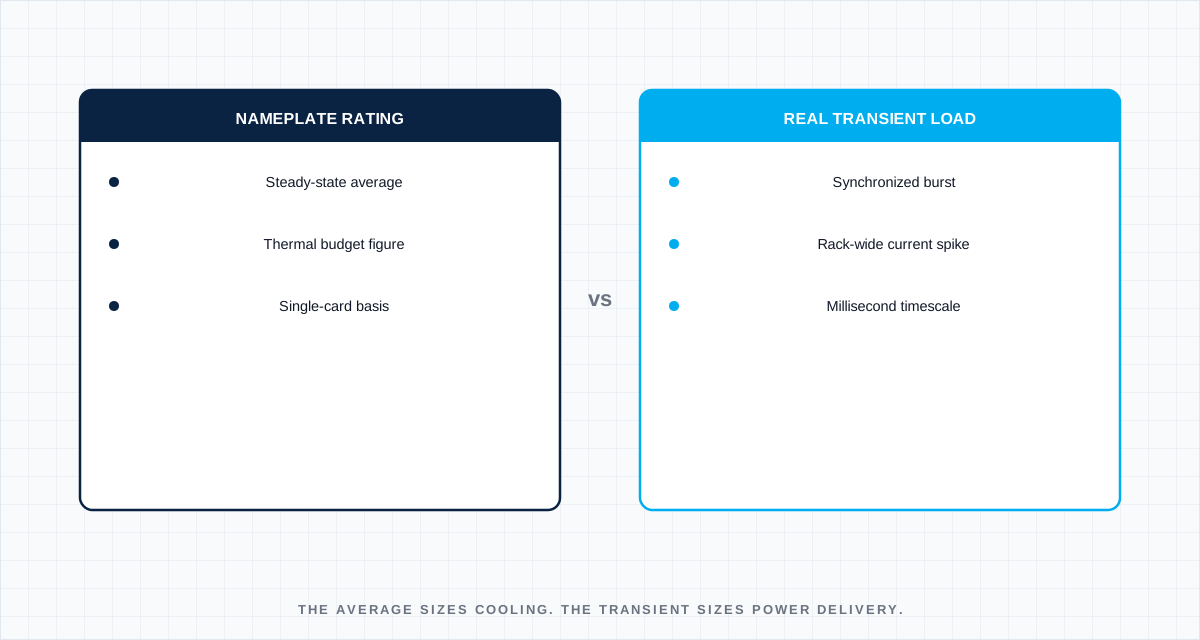
A rack of GPUs rated at a given average power draw can still trip an upstream breaker, sag a bus voltage, or overload a PDU that was sized correctly for the nameplate number — because the nameplate number describes an average, and training workloads don't draw power as an average. They draw it in sharp, synchronized bursts, correlated across every card in the rack at once, as a training step transitions from compute-bound to memory-bound and back. Power delivery engineering for AI infrastructure has to be sized against that transient behavior, not the steady-state figure on the spec sheet — a lesson industrial power electronics learned from motor inrush current and traction-inverter switching transients well before "AI infrastructurnt-load-behavior.svg)
The nameplate number was never the design constraint
A GPU's rated power draw is a useful figure for thermal budgeting over minutes, but it says very little about what happens over milliseconds. When every GPU in a rack synchronizes on the same training step — which is the normal, intended behavior of a distributed training job, not an edge case — their individual power transients stack constructively, producing a rack-level current transient that can be several times the steady-state average for a short but electrically significant window. A power delivery chain sized only to the average has correct capacity and insufficient transient headroom, which shows up as voltage sag, protective device nuisance tripping, or in the worst case, output capacitor and bus-bar stress the design never accounted for.
This is functionally the same problem power electronics engineers solve for motor inrush current and for traction inverter switching transients: the steady-state rating tells you the thermal design point, and a completely separate transient analysis tells you whether the power delivery path — conductors, bus bars, protection devices, capacitive filtering — survives the actual current waveform, not just its average.
Where the transient margin actually needs to live
The fix isn't over-provisioning every stage of the power chain uniformly — that's expensive and often still misses the specific frequency and magnitude of the actual transient. It's identifying which stage of the delivery path has the least tolerance for a fast, high-magnitude, rack-synchronized current step — usually the PDU-to-rack interconnect and the rack's own bus bar, not the upstream switchgear, which sees the transient smoothed by aggregation across multiple racks — and concentrating capacitive buffering and conductor sizing margin there, sized against the actual measured or modeled transient profile of the specific GPU platform and workload pattern, not a generic derating factor.
Why this is a power electronics problem wearing a data-center label
Treating GPU rack power delivery as a data-center facilities problem — sized from nameplate wattage and a standard power-usage-effectiveness assumption — misses the transient behavior that determines whether the design actually holds up under a real training workload. Treating it as the power electronics problem it actually is — characterize the real transient current profile, size the delivery chain's most vulnerable stage against that profile specifically, validate under synchronized multi-GPU load rather than single-card benchmarks — is what closes the gap between a design that passes a nameplate-based review and one that survives production training runs.
Define the boundary
Name the operating state, interfaces, tolerances and degraded conditions. A test without a boundary only proves the sample survived once.
Capture the right signal
Choose measurements fast and close enough to the mechanism to explain cause, sequence and margin—not just the final alarm.
Set a decision rule
Agree before the test what passes, what triggers redesign and what uncertainty requires another experiment.
Turn the lesson into a validation plan.
Bring us the requirement, failure signature or architecture boundary. We will help frame the evidence needed to make the next decision.