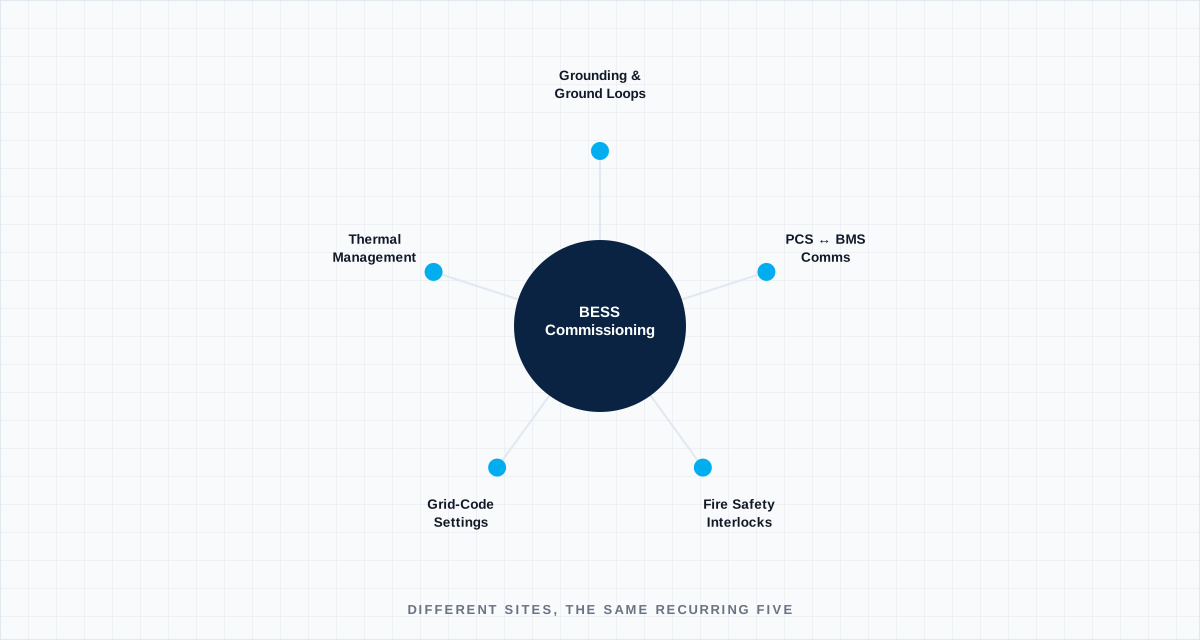
Across grid-scale battery energy storage projects with different developers, different equipment suppliers, and different sites, the specific issues that delay commissioning cluster around a surprisingly narrow set of recurring root causes. This is useful information precisely because it means most commissioning delay on a new project is not a novel problem — it's a known category that a well-scoped pre-commissioning plan can catch before equipmeacross-bess-projects.svg)
1. Multi-vendor communication protocol mismatches
The single most common source of commissioning delay: the BMS, PCS, and site-level EMS come from different suppliers, each with their own interpretation of a shared communication standard (Modbus, DNP3, IEC 61850), and integration testing reveals register mapping errors, timing assumption conflicts, or protocol implementation differences that none of the individual suppliers' factory acceptance testing — conducted in isolation, against each supplier's own test harness — could have caught.
2. Grid code parameters that were never reconfigured from factory defaults
PCS equipment ships with default ride-through, frequency response, and reactive power settings tuned to a reference grid code, and interconnection testing at a different utility's actual grid code requirements fails until those parameters are explicitly reconfigured — a step that sounds trivial and regularly consumes real commissioning time when it's discovered late rather than planned for as an explicit pre-commissioning task with the specific interconnection point's requirements in hand well before equipment arrives.
3. Thermal management validated at full state-of-charge, operated at partial
Factory thermal validation typically runs at full charge and full discharge, the cleanest test condition to specify and execute. Real dispatch operation — frequency regulation, peak shaving — spends most of its time at partial state of charge and partial load, a different thermal and electrical operating point that factory testing may never have specifically characterized, and that's where unexpected thermal or efficiency behavior sometimes first appears in the field.
4. SOC estimation drift under real dispatch patterns
BMS state-of-charge algorithms calibrated against clean, full-cycle test conditions drift under the partial-cycle patterns of real dispatch operation, and this doesn't usually show up during initial commissioning — it shows up months later, as reported capacity and actual delivered capacity diverge, right around the time performance guarantees become commercially relevant.
5. Underspecified fire safety and containment validation
Container-level thermal runaway propagation testing is expensive and sometimes gets scoped down to cell or module-level testing only, under budget pressure during initial procurement — and then becomes a hard requirement late in the project when an insurer, financier, or offtake counterparty asks for it during financial close or before commercial operation, at a point where retrofitting that validation is far more disruptive than specifying it correctly at procurement.
The pattern behind the pattern
None of these five categories are exotic. Every one of them is knowable in advance, and every one of them is cheaper to specify correctly in the procurement and factory acceptance testing phase than to discover during on-site commissioning, when schedule pressure and cost-per-day-of-delay are both at their highest. The projects that commission smoothly aren't the ones with fundamentally different equipment — they're the ones whose pre-commissioning test plans were written against this specific known list, rather than against a generic factory acceptance checklist that treats every project as if it were the first one anyone had ever built.
Define the boundary
Name the operating state, interfaces, tolerances and degraded conditions. A test without a boundary only proves the sample survived once.
Capture the right signal
Choose measurements fast and close enough to the mechanism to explain cause, sequence and margin—not just the final alarm.
Set a decision rule
Agree before the test what passes, what triggers redesign and what uncertainty requires another experiment.
Turn the lesson into a validation plan.
Bring us the requirement, failure signature or architecture boundary. We will help frame the evidence needed to make the next decision.