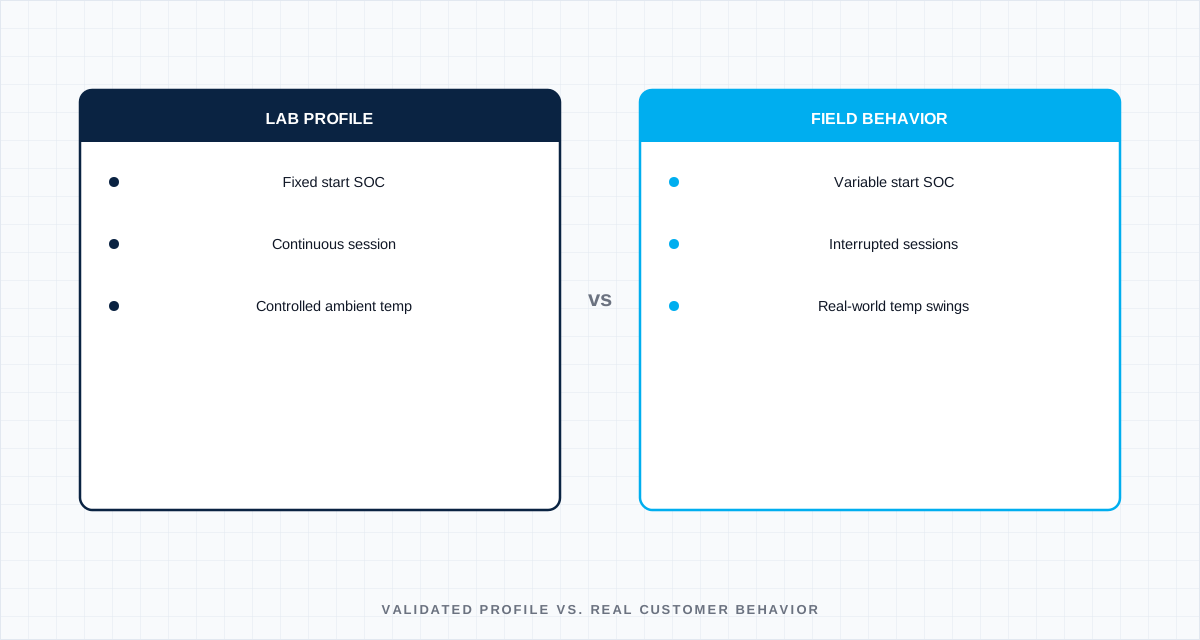
Battery charging profiles are developed and validated under controlled lab conditions: a defined starting state of charge, a defined starting temperature, a complete charge cycle run to a defined endpoint, repeated across a defined number of cycles to characterize degradation. This is the right way to characterize a charging algorithm's behavior in isolation, and it's also a meaningfully different usage pattern than what a real customer population actually produces — and that difference has real consequences for both battery longevity and thermal system design that don't show up until enough real-world field data accumfiles.svg)
The starting conditions rarely match
Lab charge cycle characterization typically starts from a stable, known state — a specific state of charge, often at or near ambient ammbient temperature, with the pack having rested long enough for temperature gradients within the pack to have equalized. Real-world charging very often starts from a pack that's still warm from a recent drive, at a state of charge that reflects whatever the driver happened to arrive at rather than a standardized starting point, and frequently begins within minutes of the vehicle being parked rather than after a rest period. None of these differences are exotic — they're simply what normal usage looks like — and each one shifts the actual thermal and electrochemical starting condition away from what the charging algorithm was primarily validated against.
Partial-cycle charging is the norm, not the exception
Full-cycle charging, from a low state of charge to a high one in a single session, is a minority behavior in most real-world EV usage patterns; most charging sessions are partial, topping up from a moderate state of charge, often overnight or during short opportunity-charging windows. This matters for two reasons that aren't always fully captured in lab validation built around full-cycle testing: first, coulomb-counting-based state-of-charge estimation accumulates error differently under frequent partial cycling than under the periodic full cycles that would otherwise provide natural recalibration points; second, some battery degradation mechanisms are sensitive to specific state-of-charge windows in ways that a validation matrix built primarily around full 0-100% cycles may under-characterize, if the real-world usage spends a disproportionate amount of time in a narrower band that wasn't the primary focus of degradation testing.
Fast-charging frequency and thermal history
Lab characterization of fast-charging thermal behavior typically tests fast-charge events from a controlled, moderate starting temperature. Real-world fast-charging frequently occurs during a road trip, where a vehicle may fast-charge multiple times in a single day with limited time between sessions for the pack to fully thermally recover — a usage pattern that's entirely normal for a meaningful segment of customers and that stacks thermal load in a sequence a single-event lab characterization doesn't capture, even if that same lab characterization correctly validates any single fast-charge event in isolation.
What this means for validation strategy
The practical implication isn't that lab-based charging characterization is wrong — it's foundational and necessary — it's that it needs to be supplemented with validation scenarios built from actual field usage patterns, not just standardized or idealized ones. Where field telemetry is available from prior programs or fleet data, the state-of-charge distribution, starting-temperature distribution, and session-frequency patterns it reveals should directly inform which non-standard charging scenarios get added to the validation matrix — repeated partial cycles from realistic starting points, back-to-back fast-charge sequences with limited thermal recovery time, and charge events beginning from an elevated starting temperature rather than only from ambient. A charging algorithm that's robust against the full range of conditions real customers actually produce, not just the range a standardized lab protocol tests, is the difference between degradation and thermal performance that matches lab predictions and a gap that only becomes visible once a real fleet has been in the field long enough to reveal it.
Define the boundary
Name the operating state, interfaces, tolerances and degraded conditions. A test without a boundary only proves the sample survived once.
Capture the right signal
Choose measurements fast and close enough to the mechanism to explain cause, sequence and margin—not just the final alarm.
Set a decision rule
Agree before the test what passes, what triggers redesign and what uncertainty requires another experiment.
Turn the lesson into a validation plan.
Bring us the requirement, failure signature or architecture boundary. We will help frame the evidence needed to make the next decision.